
Attack Of The Sacred
The generative role of semantic breakdown in collective ritual

“The way out is through”. All our best and brightest will tell you. Even if you had another choice, you can’t take it. Lefts and rights flit by as you float straight past lefts and rights. The back door (which was, upon an earlier time, the front door into which you flew) recedes like Middle Aged temples. All back doors are now too small (and fit only dead shoulders). Emerge! The way out is through. All our best and brightest will tell you. Or would. But couldn’t. Despite their devotion to emergent behavior, they couldn’t integrate the penultimate signature of emergence: informational indeterminacy. Confusion. Aporia! So they retreated into the illiterate pages of history for cover. En masse reverse diarrhea into the bowls of Christ. Sorry. Not Christ, religion. Not religion, religio. Better: religious sensations coordinated within the right ventromedial and parietal cortexes… which is religion… plain old religion, it turned out. And by religion I mean (they meant) Christianity.
They did label it properly: a meaning crisis. And then more properly: a poly crisis. And then even more properly: a meta crisis. Their solution:
Return To The Sacred1.
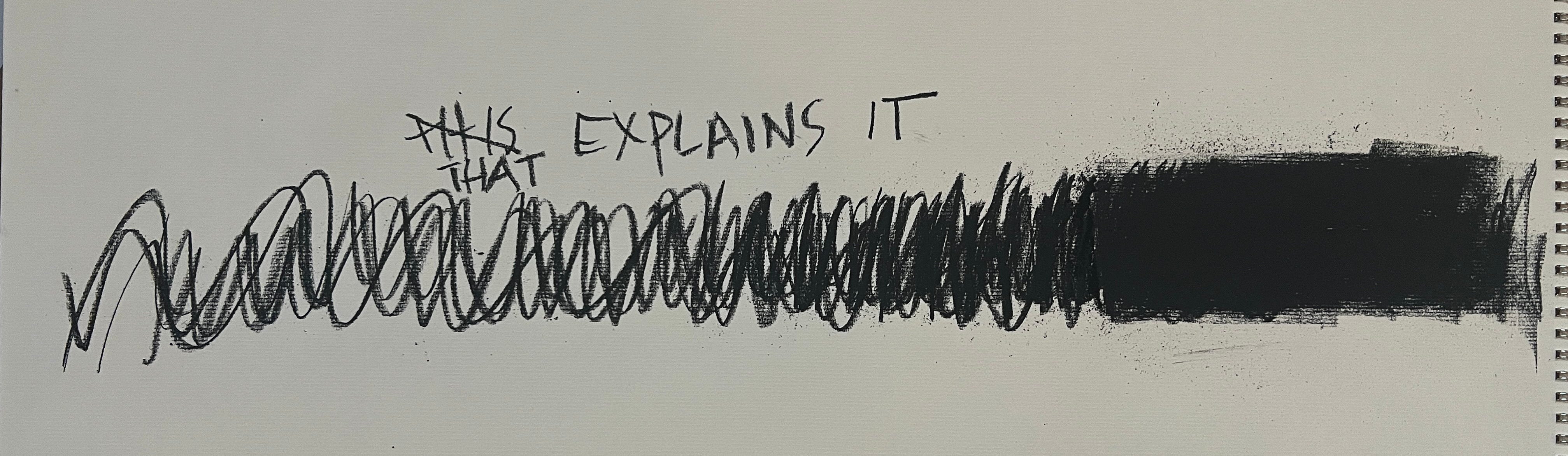
To explain the sacred is to blanch it in the balmy mouth of the profane. Which is to fail to explain the sacred. Here the etymology of “explain” is just too helpful to ignore: to “make level”, to “flatten out”. To take what was not flat and level and make it flat and level. To ex-trude what was interior and pave it plain. To condense infinite color to ink-jet black. To express the breasts and fill the cracks, to press even the most bodied bodies into bald pates.
That’s what happens when you try to explain the sacred… Unless you keep trying to explain it. If you keep talking, fast enough, long enough, you’ll eventually flood the zone. Too many words to process, too much to comprehend. It’ll all sound—and more importantly feel—like nonsense. And then you’ll have done something miraculous—you’ll have demonstrated how the sacred is produced:
Too much.
Too much of anything, really. Too much silence. Too much noise. Too much red. Too much daffodil. Too much does the trick. If you don’t think so, perhaps you haven’t not thought so’d enough. Haven’t repeated it enough. Haven’t taken it all far enough, fast enough. Repeat repeat repeat repeatre peatrepeat repeatrepeat. Overdo the profane and watch it get sacred. Just Overdo It. You know.
Like how a mantra works.
Take anything (a word, say) and repeat it ad nauseam. Take a regular word like “train” and repeat it and don’t stop until it—it—happens. ‘Till it goes from semantic to mantic, from determinate to indeterminate; until it snaps from profane to sacred. This is the epistemic flooding of semantic saturation. By sheer volume, it saturates and thereby nulls the semantic vectors of meaning, flipping from semantic meaning to mantic meaning.
Never get into a discussion about meaning and what meaning means unless you first determine which of the 2 types of meaning you’re discussing:
Semantic meaning: when something has meaning because it retains definition.
Mantic meaning: when something has meaning because it resists definition.
We all know all about the first type. Basic stuff. Understandable stuff. We use it to communicate and to orient ourselves as quickly and efficiently as possible. “The butter is in the fridge.” Got it. In secular/religious terms, this is the domain of the profane.
Mantic meaning is the domain of the sacred. We use it to dis-orient ourselves (and others) by overwhelming or otherwise subverting cognitive demands for differential clarity. This epistemic indeterminacy triggers a phenomenal binding effect that, while hindering communication, enables us to commune.
Power. God. Grace. Mantic words. Yes, they occupy space in dictionaries and are assigned definitions—but they don’t retain them. Mantic words are floating signifiers: signifiers (words) without fixed signifieds (definitive relations a word refers to). Words which, precisely because they resist definitiveness, fuel our extraordinary ability to bind ourselves to people we’ve never met. It is their lack of definition that stickies the glom of their binding power. “Binding” as in the Latin religare, “to bind”, as in religion—as in the sacred. Meaning there is nothing more patently sacred than a meaning crisis.
The meaning crisis was never damnation but salvation, cloaked in dumpster fire. The same fire our best and brightest rushed to stamp out. Yes, the online world cannibalizes the senses and saturates language beyond itself and leaves us in indeterminate stupors—but so does any religious experience worth the effort. Yes, we can and should refer ourselves to studies of upticks in suicidal ideation and antisocial behavior and on and on associated with being very online. All valid, terribly important points… but so is this one:
The sacred moves like a plague on profane streets.
E pluribus anus.
Brainrot is the most interesting thing to happen to language since language. Structuralist arguments for what qualifies as the basis of consensus reality may consider themselves under proper falsifiable strain for the first time, giving us a proper use case, at last, for the previously premature term “the meaning crisis”. In case you’re older than 40 and without children, Brainrot is what da kids call that strain of online-born language games that best rot the brain.
All sorts of brainrot-ish language games have been played throughout history2, but this is different. Pre-internet “virality” was fairly linear. Mediums didn’t have the speed to trigger en masse, non-linear, synchronous mantic episodes. None of them had access to instantaneous peer-to-peer worldwide communication. None of them had the allatonceness3 of an instant global contagion.
“Brainrot” isn’t just the name of this baroque funhouse language set—it also refers to the curious mental effects of using the language. Sufficient use of brainrot makes participants feel disoriented, absurd, and prone to inane laughter. It makes them feel like they have a rotting brain. Ha ha ha.
Sounds not good. But if we look at the fundamentals, a more complex picture emerges…
Brainrot language sets are copy pasta. Yes, “are copy pasta” is the way. And yes, that’s the name. For the thing. The way brainrot spreads. Copy copycopycop ycopycopycopyco pasta. As in copy/paste. Only pasta. That’s mass replication at scale.
Now let’s remember semantic saturation and the way a mantra works. Copy pasta is the semantic saturation mantra thing happening en masse. Instead of one person repeating it and falling into a glazed sinthome of indeterminacy, hundreds of millions. Semantic saturation and epistemic flooding. Sounds like a meaning crisis.
Six sinners, 7 prayers. Yes, “67” has graduated (via collective saturation) into symmetrical innocuity. It’s “over” only because it's now ubiquitous, as all the kids (and their parents) are still saying it, if now wistfully, as to a bygone era. But “six-seven” nevertheless still stands as the caviar exemplar of brainrot.
It is (and was) a number. Two, crucially. There is some relationship between them. The two numbers. It’s unclear what the relationship is. Impressively, intentionally unclear. What is known about 67 is that it still resists meaning—and that that’s what gives it meaning. That’s what makes it “real”. Yes, “real” as in Jacques Lacan’s notion of The Real, as, incredibly, that is the sense in which memelords use “real” to describe linguistic meaninglessness. For all my post-structuralist friends, read that last bit again. You’ve been outflanked by children. Too real fam!
67’s induction into the Miriam Webster dictionary this went like this:
Six seven (or 67 or 6 7, etc.) is a nonsensical expression.
This is the actual “definition” in Miriam Webster. There are numerous “nonsensical” words in the dictionary, but most of them—gobbledygook, hooey, hogwash, etc.—literally mean “nonsense”, rendering them semantic. Meanwhile, “67” does not mean nonsense. It doesn’t mean ‘nothing’, either. It resists definition all together.
So how is 67 used?
A few months back I spoke with my Gen Alpha daughter and four of her friends about this. As expected, they all refused to give 67 meaning, insisting that the lack of meaning was what made it quintessentially brainrot—any inherent valence or meaning would ruin the term. When I asked them if its allure was based on semiotic occlusion (the joy of confusing older generations, etc.), they again said no, giving approved examples of their school teachers participating.
I then proposed that 67’s power was in its requirement to be used spontaneously and synchronistically; that the synchronicity requirement had a ritual-like binding effect upon those participating.
Yaaassss!!, they all immediately screamed out. They were all a’glee about it. That was it. Its power came from:
A semantic indeterminacy which necessitated participatory synchronicity. And it is that participatory synchronicity which lit them up.
Small sample size, but I’ll take it.
In terms both of ritual affect and mental effect, 67 seemed to be a lot like glossolalia—only instead of just one or two freaky believers gargling the alphabet in pews, millions everywhere.
In a sidebar with R.B. Griggs, he put it too well not to quote:
Perhaps the novelty is that it represents a new linguistic function to shift the semantic landscape beyond language, to the synchronized movement of the participants. It’s a structuralist expansion into the hyper-indexical. Language is converging on interpretive dance.
Indeed. Brainrot breathes the cloud of unknowing, to get 14th century about it.
Speaking of old times…
If only Parmenides and Heraclitus ate mashed potatoes. But potatoes were hiding in Grecian latency in the Americas. So instead, Parmenides says everything is One and Heraclitus says everything is Chaos and somehow this vexed potato-less Greek philosophers so much that they named their distress The Problem of The One and The Many.
The problem of how The One and The Many relate, however, is actually pretty easy to solve—The One is just a saturation of The Many. Too many Many.
For instance. Mashed potatoes. Or mashed barley or whatever they had in their ancient kitchens. Just smash them up until you can’t tell one apart from the other—until The Many have lost their determinate features and are, indistinguishably, One. Done.
In words I prefer: the “chaos” of The Many is just the interiority of The One.
E pluribus unum.
None of this is to say that brainrot is good. What this is to say is that an age of mass ritual may be upon us. Not because we have returned to an extant religion. Not because we are exhuming Latin phrases. But because:
THE MEANING CRISIS ITSELF WAS OUR SIGNAL THAT A MASS RITUAL WAS UPON US.
I went too hard on our best and brightest in the first section and I feel bad. But for a crowd that does incessant work on emergence and teloi, I do get annoyed at their refusal to integrate the most fundamental identifier of emergence and teloi: epistemic nulls caused by systemic saturations. They paper over this requisite ignorance in various ways, some less obvious than others.
Instead of referring to the epistemic indeterminacy of emergent events, they’ll use terms like irreducibility or explanatory gap to maintain some semblance of detached observation. Instead of referring to the meaning crisis as a signal of ritualistic return qua attentional saturation, they refer to it as a malady that requires the reintroduction of attentional salience (by which, again, they almost invariably mean God).
As a result, the past 6 years of Western philosophy has summarily been Galaxy Brains talking about the meaning crisis as an object—unready to consider themselves within it as subjects.
…Until now.
Just today, one of the more verifiably genius fellows among the league of meta crisis experts (he is a chess grandmaster, after all) sent out a must-read post for anyone who has been following the crisis thing along. In summary, Jonathan Rowson seems to get it. The piece meanders beautifully, and just as he notes the crisis’ “breakdown of intelligibility”, he turns it on its head—instead of retreating from it, he suggests working with it. He suddenly puts it all together and asserts a new answer:
“Working with the imaginal realm.”
Meaning, if I may interpret, working from within the confusion—from within the informational saturation of indeterminacy—using it as a zone for collective spiritual evolution.
We may have to do precisely this kind of enigmatic work to survive the 21st century. I believe we can learn to attune ourselves to the patterns of interaction disclosed through the imaginal realm more or less well, but in ways that require context and disposition to coalesce, and perhaps spiritual training to make that happen or even just to be able to allow it to happen. It’s not easy, because the phenomena in question is less like a resource that can be harvested or instrumentalised, and more like a relationship where a common language has to be learnt to deepen the relationship.
He gets it. He goes on:
…coincidences are about the intersection of the causal and poetic orders becoming apparent to us. These kinds of encounters may even be the cosmic grammar from a mother tongue that we have forgotten how to speak.
Um, he TOTALLY gets it.
At the moment, this idea sounds niche and esoteric, but the worldview it implies is not new; but old. We have forgotten that the world speaks to us and stopped listening as if it might. It is time to start listening again.
Couldn’t have said it better myself.
By which is meant “the intimate relationship between consciousness and matter” that Christianity enacts, according to Iain McGilchrist.
A whole stack should be here devoted to Rabelais’ Gargantua and Patangruel. Alas. This link will have to do. Meanwhile, there are too many nonsense-oriented language games to mention here. Glossolalia in particular—an example that supports my argument here, me thinks, tho none of them had the benefit of the speed and reach of internet copypasta.
Allatonceness (all-at-once-ness). Marshall McLuhan’s prescient neologism for the collapsing of perceptions of time and space due to the increasing immediacy of technological communications.
Skrilla (in an interview about the meaning of 6/7): "it came from my brain"
Great post! Thanks for the mention…Let’s talk, or sing, or something…